

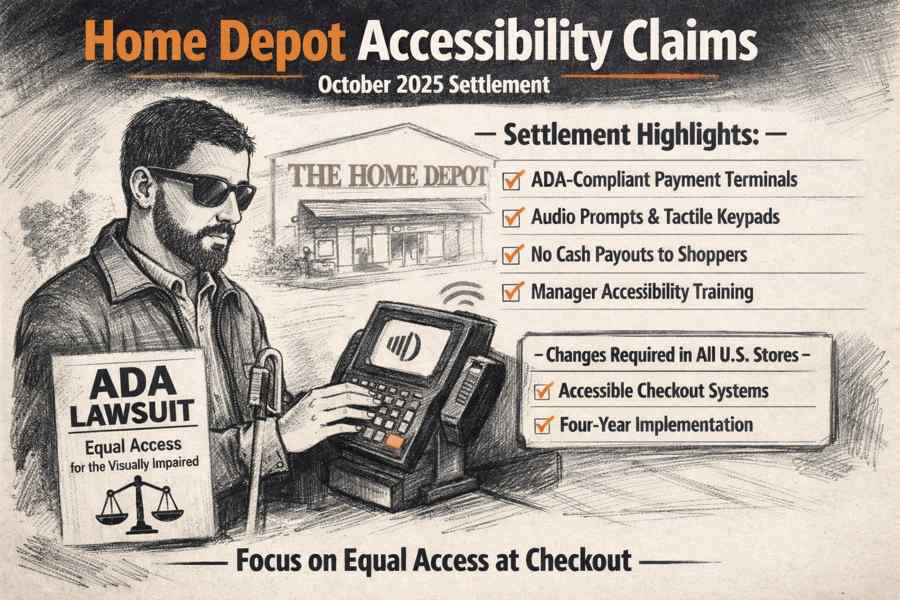
In October, Home Depot resolved a federal class-action dispute tied to checkout accessibility at U.S. retail locations. The legal action focused on in-store payment terminals that failed to support independent use by blind and visually impaired customers. The resolution required technology upgrades and operational changes rather than cash payments to shoppers, placing emphasis on equal access at the point of sale.
ADA-Based Allegations Against Checkout Systems
The lawsuit alleged violations of Title III of the Americans with Disabilities Act. Plaintiffs described point-of-sale devices that lacked audio prompts, tactile controls, or equivalent assistive functions. Without those features, visually impaired customers could not complete cash-back transactions privately or independently.
Core allegations focused on checkout experience rather than store layout or staffing policies. Attorneys argued that payment technology forms part of the retail service itself, placing it under ADA obligations.
Primary complaints raised by plaintiffs:
- Cash-back screens without spoken instructions
- Touch-only interfaces with no tactile alternatives
- Transaction steps that required third-party assistance
- Loss of privacy during payment
These barriers formed the basis of the federal filing that moved forward during 2024 and reached resolution the following October.
Settlement Confirmation and Timeline
Court records show the settlement reached final terms in October 2025, followed by scheduling of a fairness hearing set for January 2026. The agreement applied across all U.S. retail locations operated by Home Depot.
Rather than compensating customers directly, the settlement targeted structural correction. Legal fees and a service award went to the named plaintiff, while operational improvements applied chain-wide.
Terms of the October 2025 Agreement
The settlement required Home Depot to modify payment technology and management practices over a multi-year rollout period.
Required actions under the agreement:
- Installation of at least one ADA-accessible payment terminal per store
- Audio guidance for transaction steps involving cash-back options
- Non-visual navigation support through tactile or comparable controls
- Manager-level instruction on accessible checkout operation
No purchase history, proof submission, or enrollment process applied to benefit from these changes. All qualifying customers gain access through system upgrades alone.
Financial Structure of the Settlement
The monetary portion of the agreement remained limited in scope. Funds addressed litigation expenses rather than customer payouts.
| Settlement Allocation | |
| Attorney fees | Covered by Home Depot |
| Plaintiff service award | Approved by the court |
| Customer compensation | None |
| Technology upgrades | Mandatory, non-cash relief |
Who Benefits From the Accessibility Changes
The settlement applies broadly to blind and visually impaired shoppers using U.S. Home Depot locations. Access improves automatically through upgraded checkout devices.
Benefiting groups:
- Customers using screen readers or similar assistive tools
- Individuals relying on non-visual transaction cues
- Shoppers requiring privacy during debit card transactions
No claim filing, registration, or deadline applied. Access flows from physical changes inside stores.
Implementation Period and Store-Level Changes
The agreement allows Home Depot several years to complete nationwide installation. Each store must maintain at least one accessible terminal offering full transaction capability.
Store managers receive operational guidance on:
- Activating audio output features
- Responding to accessibility requests
- Maintaining compliance during terminal replacement cycles
This phased rollout accounts for supply chain logistics, software integration, and staff instruction across thousands of locations.
Legal Framework Within Retail Accessibility Enforcement
Retail accessibility litigation has expanded beyond ramps, aisles, and parking access. Courts now treat payment technology as part of the customer service environment.
Similar ADA claims across the retail sector have targeted:
- Self-checkout kiosks
- Touchscreen ordering systems
- Digital receipts and PIN pads
The Home Depot settlement fits within that enforcement pattern, signaling that checkout independence forms a civil rights issue rather than a convenience feature.
Industry Response and Compliance Pressure
Large retailers face growing legal exposure tied to transaction technology. Settlements like this one encourage earlier compliance to avoid prolonged litigation.
Compliance teams now assess:
- Hardware compatibility with assistive devices
- Software prompts for non-visual navigation
- Staff readiness for accessibility support
Failure to address these areas increases legal risk under federal disability law.
Privacy and Independence at the Center of the Case
Plaintiffs emphasized loss of transactional privacy as a major harm. Requesting help from store employees or nearby customers exposed PIN entry and cash-back choices.
The settlement framed accessibility as a matter of dignity and autonomy rather than convenience. Audio prompts and tactile navigation restore control to the customer completing the purchase.
Consumer Awareness and Advocacy Impact
Disability rights organizations highlighted the case as a reminder that equal access extends to every stage of retail interaction. Advocacy groups continue monitoring rollout progress through public reporting and store-level feedback.
The absence of direct payouts drew criticism from some observers, though accessibility advocates stressed that physical changes offer lasting benefit across millions of transactions.
Compliance Oversight and Future Monitoring
Court oversight remains in place through the implementation period. Compliance reporting obligations require Home Depot to demonstrate progress toward full deployment.
Failure to meet agreed benchmarks could reopen enforcement action under ADA authority.
It seems that Home Depot accessibility settlement reshaped how retail checkout compliance is viewed under federal disability law. By mandating accessible payment terminals and staff readiness, the agreement addressed structural barriers rather than offering symbolic relief.
As implementation moves forward, the settlement serves as a benchmark for accessibility expectations across the retail industry, placing customer independence and privacy at the center of compliance strategy.